Let's talk about the elephant in the room. If you run a retail business, supermarket, or multi-branch boutique in Sri Lanka right now, the operating environment has changed dramatically in the past year — and the margins are tighter than ever.
Between sweeping tax law amendments, the Inland Revenue Department's digital enforcement push, unpredictable supply chains, and rapidly shifting consumer payment habits, continuing to rely on a traditional paper "CR book," manual billing, or an isolated legacy desktop machine is no longer just inefficient. It is becoming financially and legally untenable.
This guide breaks down every major regulatory and operational change you need to understand — and exactly how a modern hybrid cloud POS system protects your business and keeps it compliant.
1. The Lowered VAT Threshold: Pulling Thousands of Retailers into the Tax Net
If you missed the latest government updates, the legislative landscape has shifted dramatically. A newly tabled amendment to the Value Added Tax (VAT) Act has drastically lowered the annual VAT registration threshold:
| Previous Threshold | New Threshold (Annual) | New Threshold (Quarterly) |
|---|---|---|
| Rs. 60,000,000 | Rs. 36,000,000 | Rs. 9,000,000 |
This single legislative change pulls thousands of medium-sized Sri Lankan retail shops, supermarkets, and multi-unit boutiques directly into the VAT compliance net. If you run a decent-sized grocery store, cosmetics shop, or multi-branch clothing outlet, you are likely hitting this threshold — or rapidly approaching it.
The impact is immediate: Operating a retail business past this threshold without a system capable of accurately segregating, tracking, and reporting VAT metrics is no longer viable. A tax audit under the new enforcement framework without proper digital records is a nightmare — one that a manual cashbook or a legacy machine simply cannot protect you from.
The Inland Revenue Department (IRD) is actively rolling out RAMIS 3.5 and pushing for real-time e-invoicing via secure POS systems. If your current setup cannot separate VAT and SSCL instantly and handle automated local tax calculations, you are exposed.
Learn more about VAT-compliant billing options in our guide to retail POS systems in Sri Lanka and see how a cloud-based POS system automates tax separation at the point of sale.
2. Real-Time Revenue Tracking via “Secured POS” Mandates (Section 64B)
The era of isolated, offline billing machines is coming to an end. Under the newly proposed Section 64B of the VAT Act, the government introduces strict framework protocols regarding everyday sales floor operations:
- The Mandate: VAT-registered businesses will be legally required to utilize “secured point of sale machines” approved directly by the Commissioner-General of the Inland Revenue Department (IRD).
- The Definition: A compliant system is an electronic platform capable of generating standardized invoices and capturing transaction data in real time.
- The Timeline: Once an official date is prescribed by the state, businesses will have a strict three-month window to fully transition to approved electronic devices.
This is not a distant future regulation — the infrastructure is being built now. Waiting until the enforcement date to start evaluating your billing system means you will be scrambling in a three-month window under pressure. Contact us today to understand your transition options before the deadline hits.
The Desktop Cloudashier from POSSystem.lk is designed specifically to meet these emerging compliance standards, with built-in IRD-ready tax frameworks and standardized invoice generation.
3. The RAMIS 3.5 Web-API and National E-Invoicing System
The Department of Inland Revenue has officially commenced its phased rollout of the National E-Invoicing System. This digital infrastructure initiative directly bridges individual retail locations with state financial databases.
[Retail Point of Sale (POS)] ──(Real-Time Web API)──> [RAMIS 3.5 System (Inland Revenue Dept.)]
Direct API Integration — No More Manual CSV Uploads
Instead of manual, end-of-month CSV uploads, modern billing platforms must connect directly to the Revenue Administration Management Information System (RAMIS 3.5) via a secure Web API. Sales data, output tax records, and credit/debit notes are automatically transmitted to the IRD at the point of transaction.
This system has already gone live for major export sectors and tea brokers, with the infrastructure scaling up to encompass wider domestic retail and business-to-consumer (B2C) operations.
The Critical Implication: Credit & Debit Notes Replace Manual Edits
Because the API locks transactions instantly into RAMIS to prevent tax evasion, any pricing errors or returns can no longer be edited or deleted manually on your billing dashboard. They must be structurally handled through formal, system-generated credit and debit notes. This is a fundamental operational shift that manual systems or basic legacy software simply cannot accommodate.
Our platform features include built-in credit and debit note generation, automated RAMIS-ready output tax reporting, and a complete audit trail for every transaction — exactly what IRD compliance demands.
4. The Cloud-Only Trap: Why Your Business Needs Hybrid-Cloud Architecture
Many modern software providers sell “pure cloud” POS systems. They look polished, but they hide a critical vulnerability: the moment your internet connection drops, your entire operation freezes.
Sri Lankan business owners know that connectivity can be unpredictable — local fiber cuts, mobile broadband congestion during peak hours, power fluctuations during storms in Colombo, Kurunegala, or anywhere across the island. A queue forming at your cashier counter while your POS loads a spinner costs you customers and revenue.
The Hybrid-Cloud Model: Best of Both Worlds
Our Desktop Cloudashier architecture solves this with a true hybrid approach:
- 100% Offline Capability: Your cashiers can keep scanning barcodes, issuing printed or SMS receipts, and collecting payments — entirely offline. The system never stops moving.
- Instant Cloud Sync: The moment your internet connection reconnects, all local sales data, inventory adjustments, and cash drawer logs automatically sync back to your secure cloud dashboard.
- Compliance-Ready: All queued transactions are transmitted to the RAMIS Web-API integration layer automatically upon reconnection, maintaining your real-time reporting obligations.
For a detailed comparison, read our article on Desktop vs Cloud Cashier POS in Sri Lanka to understand exactly which architecture fits your retail setup. See all pricing options for hybrid and cloud POS packages.
5. Real-Time Multi-Branch and Inventory Intelligence
Managing a single inventory is difficult. Managing stock levels across multiple branches or a central warehouse without a centralized system is nearly impossible — and a guaranteed path to wastage, over-ordering, and stockouts.
Our unified dashboard gives you complete oversight from any device:
- Live Stock Tracking: Watch stock levels deduct across all branches in real time as barcodes are scanned at every checkout counter.
- Smart Reorder Alerts: Receive automated notifications before fast-moving products sell out. Track batch numbers and expiry dates — critical for pharmacy and bakery operators — to eliminate costly wastage.
- Inter-Store Stock Transfers: Move slow-moving items from an outlet where demand is low to a branch where they are selling fast, directly from your dashboard — optimizing your working capital.
             ┌─── [ Central Warehouse / Cloud Dashboard ] ───┐
             │                                               │
             ▼                                               ▼
[ Branch 1: Colombo Outlet ]                 [ Branch 2: Kurunegala Outlet ]
  • Live Sales Sync                             • Live Sales Sync
  • Low-Stock Alerts                            • Low-Stock Alerts
  • Expiry Date Tracking                        • Expiry Date Tracking
This level of centralized, real-time inventory control is what separates thriving multi-location retail chains from those drowning in manual stock reconciliation spreadsheets. Explore the full feature set of our multi-branch management tools.
6. Seamless Digital Payments: LankaQR, Cards & Contactless
Consumer behavior in Sri Lanka has shifted massively. Nobody wants to carry thick wads of cash anymore. Customers expect to tap their card, or quickly open a mobile banking app to scan a QR code. Forcing customers into a single payment method slows down your checkout lines and loses you sales.
If your cashiers are manually entering amounts into a standalone bank terminal and then typing the same figure into a separate cash register, you are creating a guaranteed source of human error — like typing Rs. 1,500 instead of Rs. 15,000.
Unified Checkout at Every Counter
Our Android POS terminals and desktop systems integrate payment methods directly at the point of sale:
- Credit & Debit Cards: Accept Visa, Mastercard and local bank cards via integrated terminals — the exact bill amount is pushed directly to the payment device, eliminating manual re-entry.
- Contactless & Mobile Wallets: Support tap-to-pay for speed at busy counters.
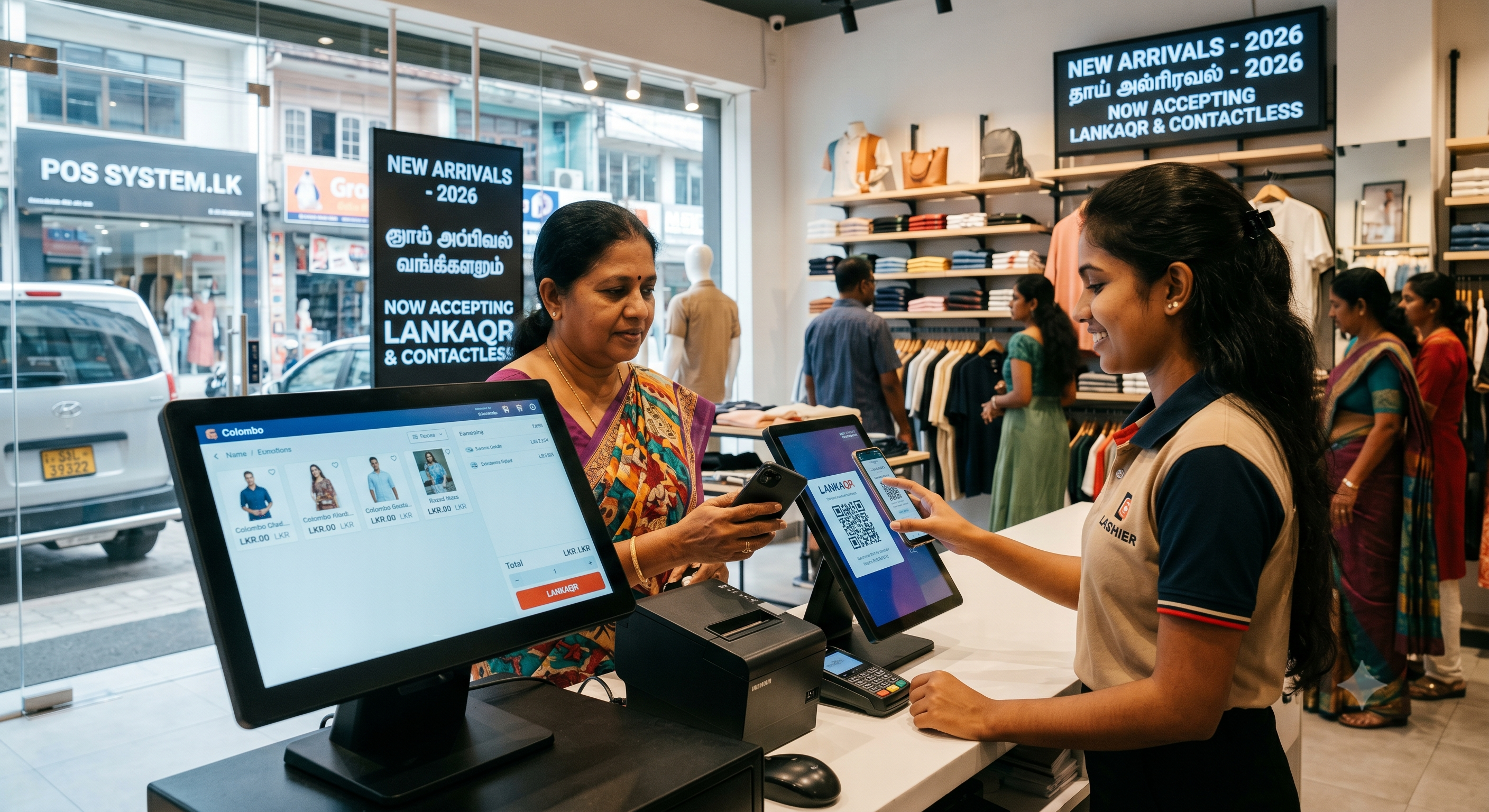
- LankaQR Integration: Generate dynamic QR codes directly on your customer-facing screen or receipt printout, allowing customers to scan and pay instantly via their preferred Sri Lankan banking app — no separate QR device needed.
Every payment method feeds into the same unified sales record, making your end-of-day reconciliation and VAT output tax calculations accurate and effortless. Learn more about our payment integration features.
7. Built for Security and Fraud Prevention
Internal leakage and pricing mistakes can quietly drain a retail shop's margins. If you are not physically sitting at the counter every hour of the day, how do you track every cash drawer opening, every discount applied, every refund issued?
Manual systems or weak legacy software make it incredibly easy for inventory to “disappear” or for unauthorized discounts to accumulate unnoticed. Our platform establishes airtight operational control:
Role-Based Access Control
Secure your system by giving cashiers unique PINs and login credentials. Restrict sensitive actions — such as issuing refunds, opening the cash drawer without a linked sale, or applying discounts above a set threshold — strictly to manager-level accounts. Every action is logged with a timestamp and user ID.
Detailed Cash Drawer Reconciliation
At the end of every shift, the system automatically calculates expected cash-in-drawer based on all recorded cash transactions. Compare this against the actual physical count to instantly highlight any discrepancies — down to the last rupee. No more guesswork, no more end-of-day surprises.
Complete Audit Trail
Every sale, refund, credit note, discount override, and login event is permanently logged in the POS system database with a timestamp and user identifier. This audit trail is not just good business practice — under the RAMIS 3.5 reporting framework, it is exactly the kind of documentation the IRD requires during a compliance review.
Pair your POS with our employee management system for complete staff activity oversight across all branches.
8. Compliance Checklist: Audit Your POS System Today
With the national digital economy strategy accelerating, retail merchants must actively audit their current software infrastructure. Continuing to use basic legacy systems exposes your business to severe transition friction, audit penalties, and reporting mismatches when regional enforcement tightens.
Use this checklist to evaluate whether your current POS provider is ready:
| Compliance Requirement | What to Check |
|---|---|
| VAT & SSCL Segregation | Does the system automatically calculate and separate VAT at the point of sale? |
| IRD RAMIS Web-API | Is the provider actively developing or deploying a RAMIS 3.5 Web API integration module? |
| Standardized Invoices | Does every receipt meet IRD standardized invoice format requirements? |
| Credit & Debit Notes | Can the system generate formal, system-stamped credit and debit notes (not manual edits)? |
| Offline Functionality | Does the system operate 100% without internet and sync automatically on reconnection? |
| LankaQR Payments | Is LankaQR natively integrated — not via a separate standalone device? |
| Role-Based Access | Can you restrict refunds, discounts, and drawer openings by user role? |
| Multi-Branch Inventory | Is stock tracked and reconciled across all branches in real time? |
| Audit Trail | Is every transaction, edit, and user action permanently logged with timestamps? |
| Local Support | Does your provider offer Sri Lankan-based 24/7 support with regular local compliance updates? |
If your current POS system fails on even two or three of these criteria, you have a compliance gap that will cost you more to fix reactively than proactively. Speak to our compliance team for a free assessment.
What We Are Doing About It at POSSystem.lk
We saw how frustrated local merchants were with expensive foreign systems that do not understand Sri Lankan business realities — different tax structures, unreliable connectivity, LankaQR requirements, and multi-language operations. That is why we engineered possystem.lk specifically for our market.
- Flawless Hybrid Architecture: Works fully offline, syncs seamlessly to the cloud. No frozen screens, no lost transactions.
- Built-in IRD & RAMIS Compliance Framework: Ready for changing local tax structures. Automated VAT/SSCL calculation, standardized invoicing, and credit/debit note generation out of the box.
- Live Multi-Branch Inventory Tracking: Manage stock in Kurunegala, Colombo, Kandy, or any branch from your phone or laptop.
- Smart Supplier & Expiry Management: Critical for pharmacies, bakeries, and grocery retailers to eliminate costly wastage and maintain compliance with product traceability requirements.
- Transparent, Local Pricing: POS systems from Rs. 39,000 with lifetime warranty, lifetime support, and customization built for your specific business type — no hidden annual fees.
The retail shops thriving today are the ones treating their billing software as an engine for growth, not just a digital cash box. Transitioning to an adaptable, cloud-first or hybrid-desktop POS infrastructure ensures your daily sales workflows remain completely unhindered by changing state regulations.
Get a Free Compliance Consultation
Frequently Asked Questions
What is the new VAT registration threshold in Sri Lanka for 2026?
Under the newly tabled amendment to the VAT Act, the annual threshold has been reduced from Rs. 60 million to Rs. 36 million (or Rs. 9 million per quarter). This change brings thousands of medium-sized retail businesses into the VAT compliance net.
What is a “Secured POS Machine” under Section 64B?
Under the proposed Section 64B of the VAT Act, VAT-registered businesses must use secured point of sale machines approved by the Commissioner-General of the IRD. These are electronic platforms capable of generating standardized invoices and capturing real-time transaction data. Businesses will have a three-month window to comply once the official date is prescribed.
What is RAMIS 3.5 and does my POS need to connect to it?
RAMIS 3.5 (Revenue Administration Management Information System) is the IRD's national tax platform. Under the National E-Invoicing rollout, modern POS systems must transmit sales data, output tax records, and credit/debit notes to RAMIS in real time via a secure Web API — replacing manual filing. The system is already live for export sectors and scaling to domestic retail. See our platform features for our RAMIS integration roadmap.
Why can’t I use a pure cloud POS in Sri Lanka?
A pure cloud POS stops completely when internet drops. Given Sri Lanka's connectivity realities, you need a hybrid model that runs fully offline and syncs automatically when reconnected. Read our desktop vs cloud POS comparison for a full breakdown.
Does POSSystem.lk support LankaQR payments?
Yes. Our systems generate dynamic LankaQR codes directly on the customer-facing display or receipt, enabling instant payment via any Sri Lankan banking app — alongside card and contactless payment support. All payments feed into a single unified sales record.
How much does a compliant POS system cost in Sri Lanka?
POSSystem.lk offers POS systems starting from Rs. 39,000 with lifetime warranty and lifetime local support — all customized to your business type. No recurring annual subscription fees for the core compliance features. View all pricing packages here.